
1. Indications and Usage
General Anesthesia: Induction and maintenance of general anesthesia in adults and children aged 1 month and older.
Sedation for Procedures: Induction of sedation for diagnostic and surgical procedures in adults.
ICU Sedation: Sedation of mechanically ventilated patients in intensive care units.
2. Dosage and Administration
Administration Route: Must be administered intravenously.
Monitoring Requirements: According to the National Medical Products Administration drug label, the drug must be used under the supervision of a physician trained in anesthesia or critical care, with continuous monitoring of respiratory and circulatory function。
Induction Dosing: For adult general anesthesia induction, the dose is typically adjusted according to individual response and clinical conditions.
Maintenance and Infusion: For procedural sedation or ICU sedation, controlled infusion using an infusion pump is recommended to titrate to the desired depth of sedation.
3. Mechanism of Action
GABA-A Receptor Modulation: Propofol acts as a central nervous system depressant by enhancing the inhibitory effects of gamma-aminobutyric acid (GABA) at GABA-A receptors.
Clinical Effects: This interaction produces rapid-onset sedation, hypnosis, and amnesia, with a short half-life due to rapid redistribution and hepatic clearance.
4. Safety and Warnings
Propofol-Related Infusion Syndrome (PRIS): Rare but life-threatening metabolic acidosis, hyperkalemia, rhabdomyolysis, and cardiac failure may occur with high-dose or prolonged infusion.
Respiratory and Cardiovascular Depression: Dose-dependent hypotension, bradycardia, and respiratory depression or apnea are common, especially during induction.
Allergy Risk: Contraindicated in patients with known hypersensitivity to propofol or emulsion components (e.g., soybean or peanut oil).
Pediatric Restrictions: Safety for sedation in ICU has not been established in children aged 16 years and younger.
5. Adverse Reactions and Clinical Research
Common Adverse Reactions: Hypotension, respiratory depression, injection site pain, coughing, and nausea.
Clinical Research: Clinical trials and extensive clinical experience demonstrate its efficacy in providing rapid induction and smooth recovery for anesthesia and sedation.
6. Drug Interactions
CNS Depressants: Concomitant use with opioids, benzodiazepines, or other general anesthetics potentiates respiratory and cardiovascular depression.
Neuromuscular Blockers: May alter the duration of action of muscle relaxants.
Cytochrome P450 Substrates: Propofol may inhibit the metabolism of certain drugs, potentially increasing their plasma concentrations.
7. Pharmaceutical Information
Active Ingredient: Propofol.
Appearance: White, uniform emulsion.
Storage: Store at controlled room temperature. Do not freeze. After opening, unused portions must be discarded immediately to prevent microbial contamination.
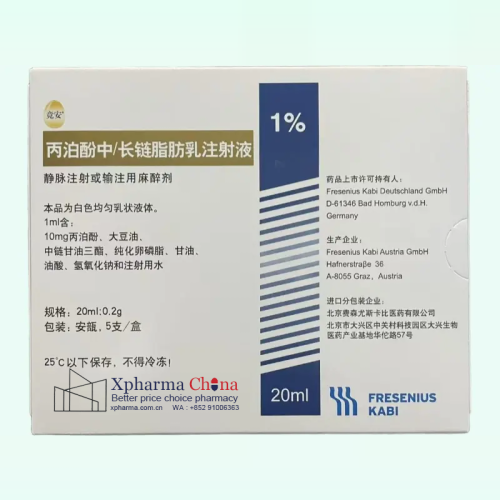
Jingan Propofol Medium and Long Chain Fat Emulsion Injection
Brand Name:竟安®( Jingan®)
Generic Name: Propofol Medium and Long Chain Fat Emulsion
Strength: 0.2 g per ampoule (20 mL, 10 mg/mL / 1% concentration), 5 ampoules per box
Manufacturer: Fresenius Kabi Austria GmbH
Marketing Authorization Holder: Fresenius Kabi Deutschland GmbH
Approval Date in China: 2006 (Original import approval date; latest renewal 2025)
Registration Number:国药准字 H20060284
Storage: Store below 25°C; DO NOT FREEZE; keep tightly sealed, away from light and out of reach of children, follow full storage instructions in the package insert
Price&Cost:Contact Us now for the best price of Propofol Medium and Long Chain Fat Emulsion(Jingan)
Only logged in customers who have purchased this product may leave a review.
Reviews
There are no reviews yet.