
1. Indications and Usage
Partial-Onset Seizures: Treatment of partial-onset seizures in adults, adolescents, and children aged 4 years and older as adjunctive therapy or monotherapy.
2. Dosage and Administration
Adults (≥17 years): The recommended starting dose is 50 mg twice daily, increased after one week to the initial maintenance dose of 100 mg twice daily. Based on efficacy and tolerability, the dose can be increased to a maximum of 200 mg twice daily.
Pediatrics (4-16 years): Dosing is weight-based. For patients ≥50 kg, adult dosing applies. For patients <50 kg, the starting dose is 2 mg/kg twice daily, titrated up to a maximum of 6-12 mg/kg twice daily depending on weight.
Renal/Hepatic Impairment: No dose adjustment is needed for mild to moderate impairment. For severe impairment or end-stage renal disease, the maximum dose should be reduced (e.g., to 250 mg/day).
Administration: Can be taken with or without food.
3. Mechanism of Action
Nav1.7 Inhibition: Lacosamide selectively enhances the slow voltage-gated sodium channel inactivation, stabilizing hyperexcited neuronal membranes.
CRMP-2 Interaction: It binds to collapsin response mediator protein-2 (CRMP-2), which may contribute to its neuroprotective effects.
4. Safety and Warnings
Cardiac Conduction: Dose-dependent PR interval prolongation may occur. Use with caution in patients with conduction abnormalities, structural heart disease, or those taking Class I antiarrhythmics.
Suicidal Behavior and Ideation: Antiepileptic drugs, including lacosamide, may increase the risk of suicidal thoughts or behavior.
Ocular Adverse Reactions: Acquired progressive infranuclear ophthalmoplegia (APIO) and secondary angle-closure glaucoma have been reported.
Hypersensitivity: Serious hypersensitivity reactions, including DRESS, have been reported.
5. Adverse Reactions and Clinical Research
Common Adverse Reactions: Dizziness, headache, nausea, and diplopia. These are often dose-related and tend to decrease over time.
Clinical Research: Clinical trials have demonstrated that lacosamide significantly reduces the frequency of partial-onset seizures with a favorable tolerance profile.
6. Drug Interactions
CYP Inhibitors: Strong CYP2C9 (e.g., fluconazole) or CYP3A4 inhibitors may increase lacosamide exposure.
Enzyme Inducers: Strong inducers (e.g., rifampin, St. John’s wort) may decrease lacosamide exposure.
Concomitant AEDs: No significant pharmacokinetic interactions with carbamazepine, valproate, or oral contraceptives.
7. Pharmaceutical Information
Active Ingredient: Lacosamide.
Appearance: Film-coated tablets.
Storage: Store at controlled room temperature, protected from moisture.
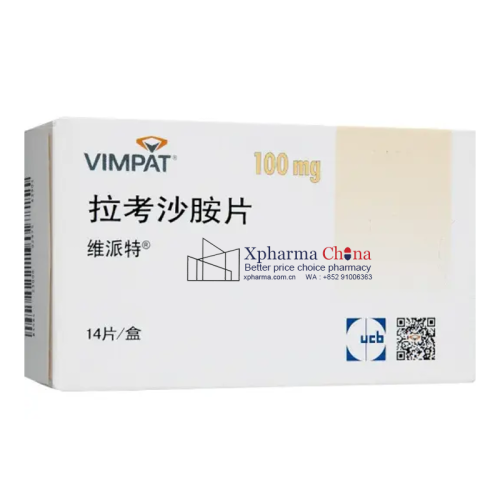
Vimpat Lacosamide Tablets
Brand Name:维派特®(Vimpat®)
Generic Name: Lacosamide
Strength: 100 mg per tablet, 14 tablets per box
Manufacturer: Aesica Pharmaceuticals GmbH (Germany)
Marketing Authorization Holder: UCB Pharma SA
Approval Date in China: 2019
Registration Number: 国药准字HJ20191026
Storage: Store at room temperature, protected from light and moisture; keep tightly sealed, out of reach of children, comply with full storage specifications in the package insert
Price&Cost:Contact Us now for the best price of Lacosamide(Vimpat)
Only logged in customers who have purchased this product may leave a review.


Reviews
There are no reviews yet.